
Resources
- Details
- Hits: 10538
Richard III: Leicester reburial under way
 Richard III's cortege will tour Leicestershire before reaching Leicester Cathedral
King Richard III's hearse has begun its journey through Leicestershire ahead of his reburial.
The cortege departed the University of Leicester after a short ceremony. It will pass places in Leicestershire associated with the former king, who died at Bosworth in 1485.
The coffin is set to reach Leicester Cathedral at 17:35 GMT, where he will be finally reinterred on Thursday.
Richard's skeleton was found in 2012, in an old friary beneath a car park.
A special morning service was held at the cathedral and a vigil was staged by a local re-enactment group at the Bosworth Battlefield Heritage Centre earlier.
Descendants of Richard III placed white roses on his coffin
The former king's coffin, which is made of English oak from a Duchy of Cornwall plantation, emerged during a ceremony led by the university's chancellor.
Archaeologists, academics, researchers and descendants of Richard III's family, including Michael Ibsen who built the coffin, placed white roses on it during the ceremony.
 The university's chancellor led a short ceremony before the cortege departed
 Canadian carpenter Michael Ibsen, a descendant of King Richard III's family, took part in the ceremony
 Richard III's remains were found under a car park in Leicester
The reburial procession began at Fenn Lane Farm, believed to be the closest spot to where the king was killed.
'Dignity and honour'
Ceremonies are due to take place as the cortege travels towards Leicester, including at Bosworth Battlefield Heritage Centre and Bow Bridge.
City mayor Peter Soulsby will meet the coffin at Bow Bridge, which marks the edge of the medieval city boundary.
He said: "It was from Leicester in 1485 that Richard rode out to battle and it was to Leicester that he returned, defeated, slung ignominiously across the back of a horse.
"It's now our opportunity to put it right and to make sure this time that it's done with dignity and honour."
The city council has announced disruption to roads and car parks for Sunday.
After a service at St Nicholas Church, the coffin will be transferred to a horse-drawn hearse before arriving at the cathedral via High Street and Grey Friars.
The council said the best places to see the cortege would be High Street, Gallowtree Gate or outside Curve Theatre.
Screens will be up at the Clock Tower and Jubilee Square showing the procession live.
There will be rolling road closures along the A47 Hinckley Road and drivers have been asked to use other routes. There will be disruption to Newarke Street, Rutland Centre and St Nicholas car parks.
Footpaths and cycle paths will remain open as normal.
 The former king's skeleton was sealed inside a lead-lined inner casket known as an ossuary earlier this week
Below is a map of the planned procession through the county. Click here for the route through Leicester city centre.
(Please note - the maps are best viewed on our desktop site).
Continue reading the main story
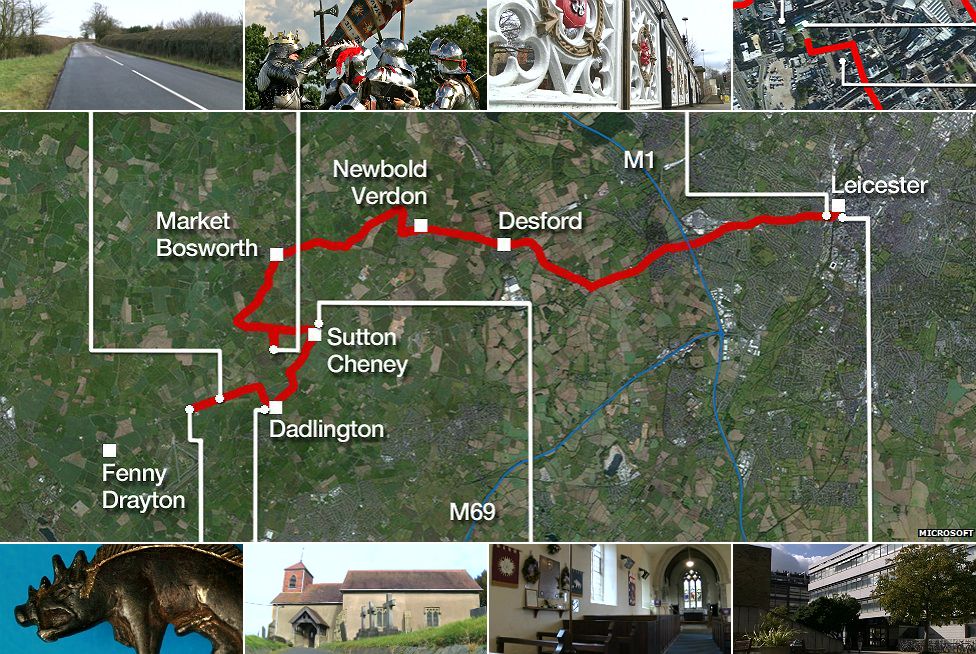
Fenn Lanes
Bosworth Heritage Centre
Bow Bridge
- Details
- Hits: 15078

Copley, John Singleton (b. July 3, 1738, Boston [Mass., U.S.]--d. Sept. 9, 1815, London, Eng.) Generally considered the finest painter of colonial America, John Singleton Copley painted portraits and historical subjects. His Boston portraits show a thorough knowledge of his New England models, and his talent as a draftsman and colorist produced pictures of aristocratic elegance and grace (emigrated to London in 1775).
Copley was born on July 3, 1738, in Boston, Mass., to immigrants recently arrived from Ireland. He began to paint in about 1753. His earliest works show the influence of his stepfather, an engraver, and the Boston artist John Smibert. In about 1755 Copley met the English artist Joseph Blackburn, whose use of rococo lightness and coloring he quickly adopted. He also made use of the rococo device called portrait d'apparat--portraying the subject with objects associated with his daily life--that gave his work a distinction not usually found in 18th-century American painting.
Eager to expand his reputation beyond New England, Copley sent his Boy with a Squirrel in 1766 to the Society of Artists in London. It was praised by both Sir Joshua Reynolds and by the transported American artist Benjamin West, who urged him to come to London. He did so in 1774 and painted his first important work, Watson and the Shark, there in 1778. In this painting Copley used what became a frequent theme of 19th-century Romantic art, the struggle of humans against nature. Although he remained in England the rest of his life and was moderately successful, his historical paintings never had the vitality or realism of his Boston portraits.
Copley died in London on Sept. 9, 1815.

| Charles Callis Western and his brother Shirley |
| Painted by John Singleton Copley in 1783 |
Watson and the Shark - 1778

Portrait of Mrs Gill circa 1770-1 Oil on canvas (Oc) support 1280 x 1022 mm Presented by Mr and Mrs H.J. Heinz II 1979

Study for `The Collapse of the Earl of Chatham' circa 1779 Oil on canvas (Oc) frame 847 x 1170 x 67 mm support 714 x 1045 mm Purchased 1879

The Collapse of the Earl of Chatham in the House of Lords, 7 July 1778 1779-80 Oil on canvas (Oc) support 2286 x 3073 mm Presented by the Earl of Liverpool 1830

The Death of Major Peirson, 6 January 1781 1783 Oil on canvas (Oc) frame/transit frame 2600 x 3700 x 200 mm support 2515 x 3658 mm Purchased 1864

The Siege and Relief of Gibraltar, 13 September 1782; ?replica circa 1783 Oil on canvas (Oc) frame/transit frame 1690 x 2235 x 100 mm support 1346 x 1899 mm Purchased 1868

Study for `The Death of Major Peirson' circa 1783 D[pi] support 356 x 575 mm Purchased 1939

- Details
- Hits: 23477

| WILLIAM HOGARTH (1697-1764) | .jpg) |
LINK TO MANY OTHER OF HIS FAMOUS AND NOT SO FAMOUS WORK |
· Painter and engraver, internationally celebrated and a champion of 18th century British artists
· Became known by engraved reproductions of his satirical and moral paintings - famously the Harlot's Progress (1732), the Rake's Progress (1733-1735) and Marriage a la Mode (1743-1745)
· Gin Lane illustrates the commonplace of drunkenness in London
William Hogarth painted a picture called The March to Finchley depicting a soldier, on side being tugged by a dark-cloaked, haggard female with a swinging crucifix who clutches the newspapers of the day. On the other arm is a comely lady, heavily pregnant, a basket on her arm contains a scroll saying 'God Save the King'. The soldier is Hogarth's Britain and the two women are fighting for his soul. The dark figure is Catholicism in the form of the Jacobites. The lady in white is for the monarch and the child she carries is Britain's child.
| TIMELINE | |
| 1727 George I dies George II becomes king | 1742 Pelham becomes Prime Minister |
| 1728 Irish Catholics deprived of the vote | 1745 Last Jacobite Rebellion breaks out |
| 1731 Captain Jenkins loses his ear | 1746 Jacobites defeated at Cullodan |
| 1739 War of Jenkins' ear against Spain | 1751 Death of Frederick Prince of Wales |
| 1740 Famine in Ireland War of Austrian Succession | 1754 Tom Pelham, Duke of Newcastle becomes Prime Minister |
| 1742 Walpole resigns | 1756 Pitt the Elder becomes Secretary at War Seven Years' War starts |
| 1760 George II dies George III becomes king | |
- Details
- Hits: 23466

WILLIAM I, THE CONQUEROR (1027?-1087), was the first Norman king of England. He took power in 1066, following his army's victory over the Anglo-Saxons of England. As king, William maintained tight control over the country's central government.
William was born at Falaise, in the Normandy region of northwestern France. He was the son of Robert I, Duke of Normandy, and inherited Normandy in 1035, at about the age of 8. During his youth, there were many disorders. In 1047, William put down a great rebellion at the battle of Val-es-dunes, near Caen, with the aid of his lord, King Henry I of France. From that time on, William ruled Normandy with an iron hand.
William claimed that King Edward the Confessor of England promised him succession to the English throne as Edward's nearest adult heir. However, Edward's brother-in-law Harold became king in 1066 through a deathbed grant by Edward and election by the nobles.
William promptly prepared to invade England. But before William could sail, the king of Norway invaded northern England. King Harold hurried north and defeated the Norwegian invaders at Stamford Bridge, near York. William landed before Harold could return to defend the southern coast. The Normans destroyed the Anglo-Saxon army and killed Harold at the Battle of Hastings on Oct. 14, 1066.
On Christmas Day, 1066, William was crowned king. William then put down local rebellions. He took lands from those who resisted him. He kept some of these lands for himself and gave the rest to his followers in return for military service. To emphasize the lawfulness of his crown, William confirmed the laws of Edward the Confessor and kept all the powers of the Anglo-Saxon monarchy. He levied Danegeld, the only national tax on landed property in all of Europe at that time. At Salisbury in 1086, he made all the landholders swear allegiance directly to him as king.
William was devout, firm in purpose, and unchanging in gaining his ends. His greatest monument is Domesday Book, a survey of the land and principal landholders of his realm.
KING 1066-1087 14 Oct 1066 = Battle of Hastings.
William of Normandy is renowned in English history as the Conqueror but to his
contemporaries he was known as William the Bastard. His father Robert was Duke
of Normandy, but his mother Herleve was the daughter of a Falaise tanner,
albeit a prosperous one. Although Herleve bore her ducal lover two children, of
whom William was born either 1027 or 1028, the social gap meant there was no
question of marriage. Herleve was later married off to one of Duke Robert's
vassals, by which gentleman she had two or more sons: Robert who became Count
of Mortain and a mighty Anglo-Norman baron, and Odo who became Bishop of
Bayeux, an equally mighty prince of the Church.
Bastardy was then common, and being illegitimate was not necessarily a bar to
inheriting a natural father's land or title, but when William was born it was
becoming more of a handicap. There was a strong reforming movement within the
Christian Church which aimed, among other things, to enforce its teachings more
strictly, including the sanctity of holy matrimony. When in 1034 Duke Robert
decided to go on a pilgrimage to the Holy Land. the good lick necessary in any
successful life smiled for the first time on William, for the duke had no
legitimate children and therefore decided to recognise his bastard son as his
heir. More surprisingly, he managed to persuade the Norman nobility to swear
fealty to the boy. While returning from the Holy Land in 1035, Robert died
suddenly and the eight/ or nine year old William found himself Duke of Normandy.
For a while the Norman lords kept their word and recognised the boy as their
lawful Duke but with the death of his powerful protector, anarchy reigned. For
ten bloody years William's luck held and the warring factions managed to kill
each other rather than him, but it was not until 1054, when he was twenty/six
or seven years old, that he finally emerged as the undisputed Duke of Normandy.
In the process he had become a man of iron, but he was also a man of God who
feared for his immortal soul and he was not without vision and imagination. He
appreciated that force was not the sole answer to the problem of ruling men,
even if it was a major factor. In the Years from 1054 to 1066 William not only
consolidated his power in Normandy - and extended it into the bordering country
of Maine - he reorganised the structure of Norman society.
As early as 1049, long before he became one of the most powerful rulers in
mainland Europe, William had acquired sufficient reputation to negotiate a
marriage with Matilda, a daughter of Count Baldwin of Flanders. This alliance
was a political coup and despite papal disapproval he went ahead with the
marriage, a bold action for a devout Christian ruler. Physically he and Matilda
were an ill/assorted pair; she was a little over four feet tall, whereas he was
close to six feet, immensely strong and tough, with a harsh guttural voice.
Mentally they seem to have been well attuned and the marriage was remarkably
successful, particularly if it is remembered that political gain and interest,
not love or even compatibility, were the hallmarks of royal alliances.
As the Norman empire expanded William was able to leave his wife as regent, a
task she performed with great efficiency and loyalty. She bore him at least nine
children and he earned a reputation for total fidelity which was even more
remarkable that their marital harmony. Fortune again favoured him in his
marriage with a wife whom he could trust, not a quality of which he had had
much experience in the treacherous, turbulent years of his youth.
When thoughts of adding the kingdom of England to the dukedom of Normandy first
entered William's mind is a matter of conjecture. It is possible hid
determination to marry Matilda was prompted by such an idea, because she was a
direct descendant of Alfred the Great, whereas his relationship to the English
monarchy was much more tenuous. In fact there was no established right of
succession in England at the time, so it was a question of who could lay claim
to the throne. In the Norman version of events leading up to 1066 - as depicted
in the Bayeux tapestry and by the Anglo-Norman chroniclers - Duke William
visited King Edward in London in 1051. Edward - known to posterity as the
Confessor - had spent much of his childhood in exile at the Norman court and
was to an extent Norman/oriented. During the visit he is supposed to have
promised that he should he die without an heir Duke William would be his
rightful successor. Then there is a leap to 1064 and the arrival of Harold
Godwinson in Normandy, by which time it had become obvious that King Edward
would not produce an heir.
Harold was a member of the family which had established itself as the Earls of
Wessex and after some changes of fortune had become the most powerful in
England. He had as good (or bad) a claim to the English throne as William, with
the extra factor that he was a native of the country. Whether Harold actually
intended to go to Normandy in 1064 and what his mission was if he did, is now a
matter of dispute. The Norman version is that Harold arrived in Normandy,
albeit via the domain of Ponthieu, explicitly to reaffirm his allegiance to
Duke William as the next rightful King of England, nominated by King Edward.
And moreover that he swore allegiance on sacred relics , though where he
actually swore his oath varies even in the Norman accounts.
This episode is the crux of the Norman version. Once Edward the Confessor died
in January 1066 and Harold Godwinson had himself crowned king, William was
morally and legally entitled, even driven, to fight for the inheritance which
had been usurped. The version was accepted at the time by other European rulers
and, most importantly, by the Pope. William was able to land in England with
the papal seal of approval for a justified invasion, bearing a holy banner.
(His half-brother Odo, who as a Bishop was not supposed to carry arms, arrived
wielding a holy sceptre). The Norman account can be accepted as a truth or seen
as evidence that in the propaganda war - as it would now be called - Duke
William beat King Harold even more decisively than he did in battle.
The last Saxon king of England has since had many apologists. They deride the
idea that King Edward would have willed away his crown as early as 1051, or even that the
Saxon Harold would have gone to Normandy specifically to swear allegiance to a
Norman duke; if he did swear, it was under duress and therefore an invalid
oath. There is general agreement that as Edward the Confessor lay dying he
nominated Harold as his successor and he was thus accepted by the Witanegemot
(the assembly of Saxon nobility). But the Normans explained that this
nomination was extracted from a dying, unworldly, perhaps slightly senile man
and was itself invalid, apart from the fact that Harold had forsworn himself.
Early in 1066 Harold had the crown of England with the consent of his peers,
but also with the knowledge that Duke William of Normandy considered it his by right. Harold soon
called up the fyrd ( a Saxon militia of freemen) in the south of England and
they responded. The months went by; Harold was more or less forced to disband
the fyrd because while they were willing to fight, they were not disciplined to
wait. Then in the middle of September another expected invader actually
arrived, Harold Hardrada of Norway who was a claimant to the English throne.
Hardrada's claim was as good as anybody's: it lay through Edward the
Confessor's Anglo-Danish predecessors Kings Canute and Hardacanute and promises
allegedly made by them to Hardrad's father.
King Harold marched north and on 25 September inflicted a crushing defeat on
Harold of Norway at Stamford Bridge, near York. Again the necessary element of
luck was with William, because as his enemy Harold Godwinson went to kill the
other serious claimant Harold Hardrada for him, the weather changed for the
better. On 12 September William's forces landed at Pevensey in Sussex, with
neither the fyrd nor King Harold's own troops to oppose them. However, there
was nothing lucky about the way William overcame his Norman nobles' reluctance
to support an invasion of England (they thought he was over-reaching himself),
nor in the way he organised his invasion forces. That was a masterly piece of
planning and staff-work, assembling men, horses, ships, weapons, supplies and
then keeping them disciplined and intact while they waited and waited for
favourable weather conditions.
In the meantime, having fought a long, bitter and bloody battle at Stamford
Bridge, King Harold marched back to London, had a brief respite, gathered more troops and marched
south to meet the Normans. It might have been wiser if Harold had rested longer
and reorganised his tired army particularly as William was being extremely
cautious and had done nothing more than establish a bridgehead slightly nearer
to Hastings. But Harold presumably believed that attack was the best form of
defence and on 14 October an event took place of which virtually everybody in
Britain knows the date, the battle of Hastings 1066.
It was, as the Duke of Wellington said later of another battle, a damn close
run thing; but as darkness fell King Harold lay dead, though probably not with
an arrow in his eye, and the Saxon forces scattered into the night.
Update: from Queen's Official Web Site 8/10/97.
The Normans
William I
The victory of William I, 'the Conqueror' (reigned
1066-1087) at Hastings and his subsequent
coronation in Westminster Abbey on Christmas
Day 1066 did not give him complete control of
England. Remaining resistance was, however,
severely crushed and castles were built to control
the country (including a fortress on the site of
Windsor Castle, and the White Tower at the
Tower of London). The lands of defeated Saxon
nobles were given to William's followers in return
for military service by a certain number of knights,
so that the tenants' foremost obligation was
allegiance to the king. This firmly established the
feudal system. In 1086, William commissioned the
Domesday Book, to record land holdings for the
assessment of taxes and other dues. William spent
long periods in Normandy to maintain his authority
there, dealing with rebellions and French invasions.
William died in 1087 leaving Normandy to his
eldest son, Robert, and England to his second son,
William II Rufus (reigned 1087-1100).

Sponsored Link - Wheat Bags USA & UK

We are UK Manufacturers and Retailers of Luxurious Microwave Wheat Bags
Having been established since 1997, we have used our experience with wheat bags and natural healing, to put together wonderful, locally sourced British ingredients to create our range of luxuriously soft and scented cushions filled with wheat.
http://www.painreliefcushions.co.uk Click for UK site and UK orders
http://www.ease-pain.com Click for USA site & USA orders
We now have a store on ETSY to sell to the whole World.
Please visit our Genealogy Items Pinterest Board
Follow Website Hosting Sussex's board Genealogy Items on Pinterest.